PALEONTOLOGISTS DISCOVER EARLIEST EVIDENCE OF RIB-POWERED BREATHING IN 289-MILLION-YEAR-OLD FOSSIL
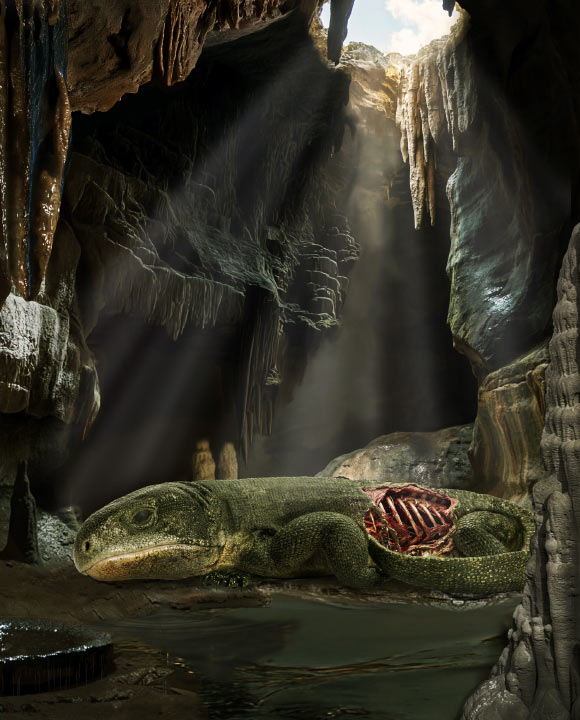
Paleontologists have made a remarkable discovery regarding the evolution of respiratory systems in early terrestrial vertebrates, examining 289-million-year-old specimens of the early reptile Captorhinus aguti that preserve three-dimensional skin coverage, complete shoulder girdles, ribcages with cartilage structures, and protein remnants. This discovery pushes back the earliest evidence of rib-powered breathing by nearly 100 million years compared to previously documented examples, fundamentally altering scientific understanding of how ancient reptiles respired.
The specimens of Captorhinus aguti represent an extraordinary paleontological find because of their exceptional preservation. Unlike most fossils, which preserve only hardened skeletal structures, these specimens have retained soft tissue impressions, cartilage structures, and even protein residue from the original organisms. Such preservation is remarkably rare and requires very specific environmental conditions during fossilization, making these specimens invaluable for understanding anatomical details often lost in the fossil record.
The complete ribcage and shoulder girdle preserved in these specimens provide direct evidence of the skeletal structures involved in respiration during the early evolution of terrestrial vertebrates. The presence of cartilages connecting ribs to the vertebral column and sternum indicates the presence of rib-powered breathing mechanisms, where muscular contraction and relaxation of intercostal muscles between ribs allowed for air movement into and out of the lungs.
Captorhinus aguti represents an important transitional form in vertebrate evolution, occupying a position in the evolutionary tree that helps scientists understand how early reptiles adapted to fully terrestrial lifestyles. The development of effective breathing mechanisms was crucial for survival on land, where the density and composition of air differs significantly from aquatic environments. Early terrestrial vertebrates had to evolve or modify respiratory systems inherited from aquatic ancestors to function effectively in air.
The presence of protein remnants in these specimens is particularly significant because proteins can contain evolutionary information. Ancient proteins may retain amino acid sequences that reflect the original biological material, potentially providing genetic information about these ancient organisms. Advances in paleoproteomics, the study of ancient proteins, have enabled scientists to extract and analyze these molecular fossils, revealing details about the biochemistry of extinct species.
Previous understanding of rib-powered breathing in early vertebrates was based on specimens from more recent geological periods or on inference from the skeletal anatomy of later species. These Captorhinus aguti fossils provide direct anatomical evidence of the respiratory system's structure and confirm that rib-powered breathing evolved earlier than previously documented.
The research demonstrates how exceptional fossil preservation can revolutionize paleontological understanding. By preserving three-dimensional anatomy, soft tissues, and biochemical information, these specimens enable paleontologists to study ancient organisms with unprecedented detail and accuracy, leading to discoveries that reshape our understanding of evolutionary history and the adaptation of life to terrestrial environments.
Permian Fossil is Earliest Evidence of Rib-Powered Breathing
Admin
Apr 09, 2026
1 Views
3 min read
Source:
Sci.News