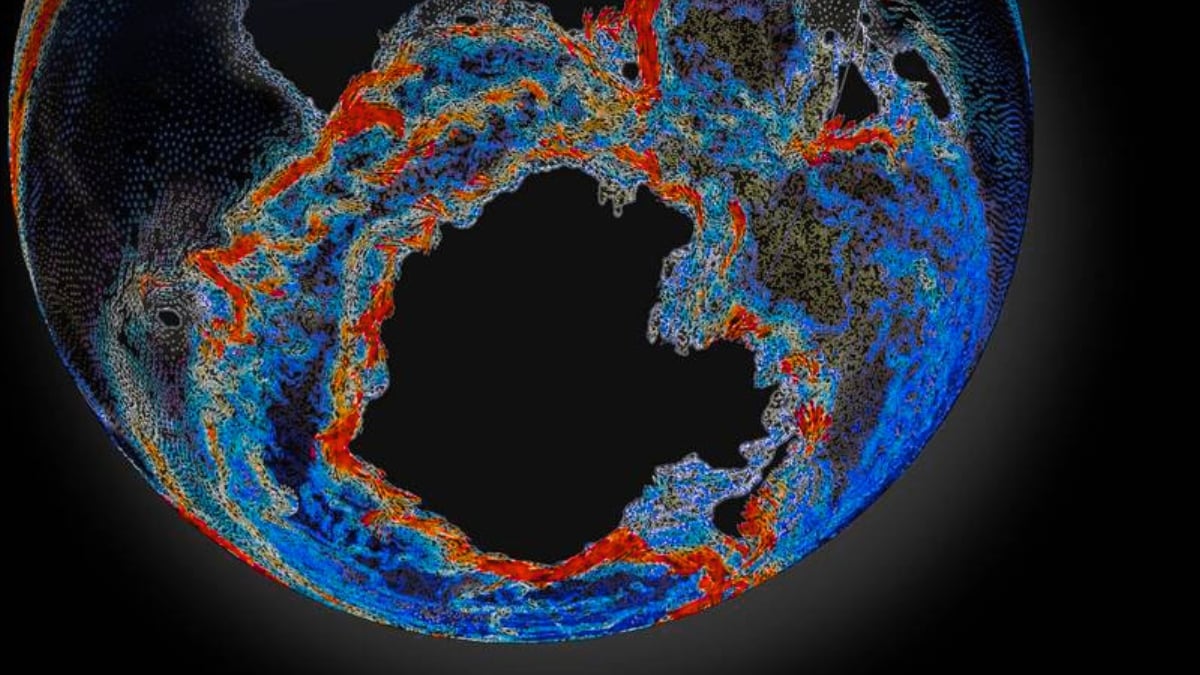
NEW OCEAN CURRENT SIMULATIONS EXPLAIN HOW EARTH'S MOST POWERFUL WATER FLOW BEGAN
Advanced computer simulations have provided unprecedented insight into the formation and initiation of Earth's strongest ocean current, revealing that the process was far more complex than previously understood. The research demonstrates that multiple major environmental and geological factors needed to align precisely before this powerful current system could begin exerting its significant influence on global climate patterns.
Ocean currents serve as critical components of Earth's climate system, transporting heat, nutrients, and organisms across vast distances. The world's strongest ocean current represents a fundamental feature of planetary oceanography, yet scientists have long puzzled over the specific conditions and timing that allowed this powerful system to develop. New simulation models are now providing detailed answers to these long-standing questions.
The research indicates that the initiation of this ocean current required the convergence of several prerequisite conditions. These included specific configurations of continental landmasses, appropriate ocean basin geometry, particular atmospheric circulation patterns, and the right combination of temperature and salinity gradients in ocean water. No single factor alone could trigger the current's formation; rather, the simultaneous alignment of multiple variables was necessary.
Paleoceanographers and climate scientists have long recognized that ocean currents have played crucial roles in shaping Earth's climate throughout geological history. Changes in ocean circulation patterns have been linked to major climatic transitions, the distribution of marine life, and even the evolution of human civilizations. Understanding how major current systems originate provides insights into how climate systems have changed in the past and how they might change in the future.
The simulations employed by researchers incorporated sophisticated modeling of fluid dynamics, temperature distributions, and continental configurations as they existed during the relevant geological period. By systematically varying different parameters, scientists could identify which factors were essential for current initiation and which were secondary or supplementary.
The findings have important implications for understanding how ocean circulation might respond to future environmental changes, including those induced by climate change. If the current system's initiation required such specific conditions, researchers are investigating whether disruption of these conditions could fundamentally alter or stop the current's operation, with potentially severe consequences for global climate patterns.
The research also demonstrates the value of advanced computational modeling in paleoceanography. By creating virtual ocean systems and testing different scenarios, scientists can explore historical conditions and processes that would otherwise remain inaccessible to direct observation. This research methodology is expected to drive future discoveries about ocean systems and their critical role in maintaining Earth's climate stability.
New Simulations Reveal How Earth's Strongest Ocean Current Got Started
Admin
Apr 09, 2026
1 Views
3 min read
Source:
ScienceAlert